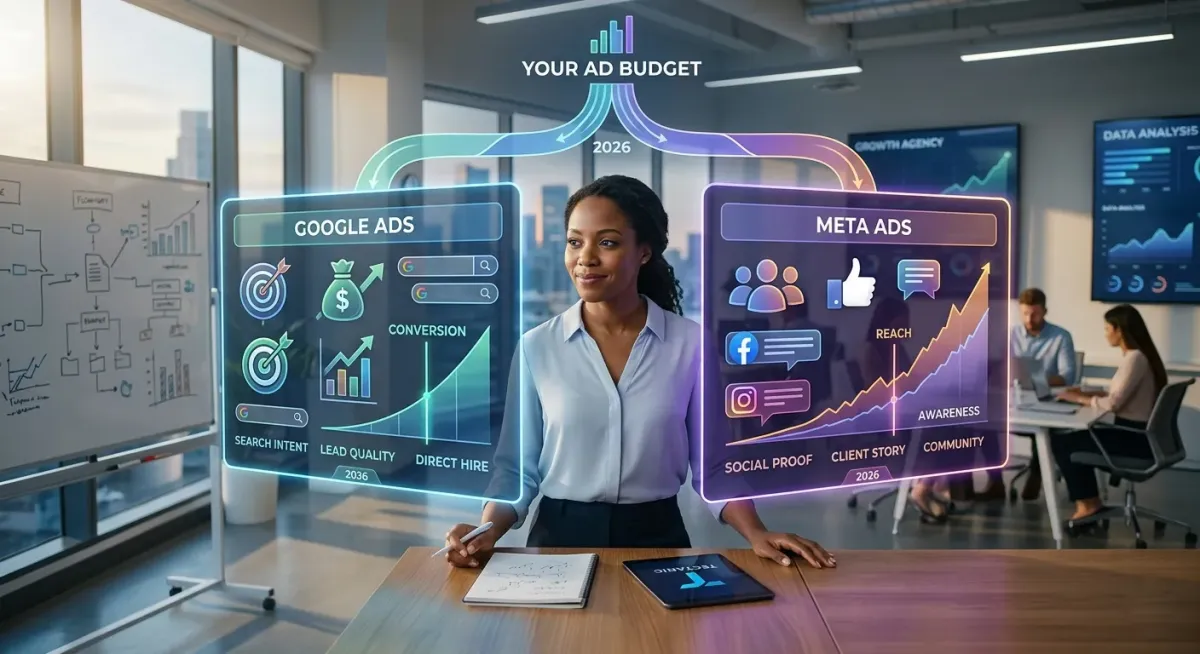
Google Ads vs Meta Ads for Coaches in 2026: Where Should Career Coaches Actually Put Their Ad Budget?
Something big just happened in digital advertising, and if you're a career coach spending money on ads, it directly affects your next budget decision.
For the first time in history, Meta is projected to overtake Google in global ad revenue in 2026. According to eMarketer's April 2026 forecast, Meta is on track to generate $243.46 billion in net worldwide ad revenue this year, edging past Google's projected $239.54 billion. Meta's global growth rate is accelerating at 24.1% compared to Google's 11.9%.
This isn't just a financial headline. It's a signal. Marketers are voting with their wallets, and they're increasingly choosing Meta.
But here's the real question no one is asking: When it comes to Google Ads vs Meta Ads for coaches, does that shift actually matter for career coaches?
The answer is: it depends on where your clients are in their buying journey. Let me break this down for you.
WHY META IS WINNING RIGHT NOW
Meta's rise isn't an accident. It's the result of a deliberate platform bet on AI-powered automation, short-form video, and behavioral targeting at scale.
Meta's Advantage+ campaigns use machine learning to optimize targeting, creative, and bidding simultaneously. For career coaches specifically, Meta Advantage+ removes the guesswork of manual audience building. The platform's AI has gotten so good at finding the right buyer that advertisers are reporting stronger returns without manually building out audience segments. That's a significant shift from even two years ago, when Meta required more hands-on audience management.
Reels have also become a serious ad placement. Advertisers who were skeptical of video are now allocating significant budgets to Reels because engagement data is strong enough to justify the move.
Google, meanwhile, faces growing headwinds. AI-driven search results are changing how users interact with the platform. More searches are ending without a click, meaning someone asks Google a question, gets an AI-generated answer, and leaves before ever seeing a paid ad. That's a structural problem for a business built on search ad clicks.
So the momentum story clearly favors Meta right now. But momentum doesn't mean Meta is the right platform for every business.
HOW EACH PLATFORM ACTUALLY WORKS, AND WHY IT MATTERS FOR COACHES
To make a smart budget decision on Google Ads vs. Meta Ads, you need to understand the fundamental difference between how each platform reaches people, especially when running paid ads for career coaches.
Google is a demand-capture platform
People go to Google because they are actively searching for something. When someone types "career coach for senior executives" or "how to get promoted faster," they already have the problem in mind. They're looking for a solution. Your ad meets them at that moment of intent. This is why Google tends to convert faster; the user already did half the work of convincing themselves they need help.
Meta is a demand-generation platform
Users on Instagram and Facebook aren't searching for anything. They're scrolling. Your ad interrupts that scroll and introduces them to a problem they may not have consciously connected to your service yet. This takes longer to convert, but it reaches a far larger audience, and it's incredibly effective at creating awareness and desire at scale.
For career coaches, both of these mechanics matter at different stages of your funnel.
WHERE META WINS FOR CAREER COACHES
Meta, including Facebook ads for coaches and Instagram placements, is the stronger platform in these specific situations:
You're building brand awareness
If your name isn't known in your niche, Meta lets you get in front of your ideal client repeatedly across Facebook and Instagram. Someone might see your ad three times over two weeks before they book a discovery call. That's the platform working as designed.
Your target client spends time on social
Most professionals in the 30–55 age range, the demographic most career coaches serve, are active on Facebook and Instagram. They're consuming content, watching Reels, and engaging with posts between meetings and in the evenings.
You're promoting a free resource or lead magnet
Meta's algorithm responds well to low-friction offers, a free guide, a quiz, and a webinar. These perform strongly for career coaching lead generation because the user doesn't need a lot of intent to say yes to something free. This lets you build your list and nurture toward paid programs.
You're retargeting warm traffic
Meta's retargeting capabilities are among the best in digital advertising. If someone visited your website, watched your video, or engaged with your Instagram account, Meta lets you serve them specific ads based on that behavior. For coaches with an existing audience, this is high-leverage spend.
Your coaching offer has a strong visual or emotional story
Career transformation is emotional. Meta's video and image formats let you show the before-and-after in a way that Google search ads simply can't.
WHERE GOOGLE WINS FOR CAREER COACHES
Google search ads for career coaching outperform Meta in these scenarios:
Your client already knows they need a career coach
When someone is actively searching for "executive career coach" or "career coaching for women in tech," they have high purchase intent. Google puts you in front of that search at the exact right moment. The conversion path is shorter.
You're targeting a specific geographic market
If you run a local or regional coaching practice, Google search ads tied to location work well. Someone searching "career coach in Chicago" is telling you exactly who they are and what they need.
Your offer is high-ticket and requires trust-building
Google's search format, paired with a strong landing page and testimonials, works well for premium programs because the user arrives with intent and is willing to invest time in evaluating you. The quality of the click tends to be higher, even if the volume is lower.
You want faster initial results
Google campaigns can generate qualified inquiries quickly because you're tapping into existing demand. If you're launching a new coaching program and need leads in the next 30 days, search ads can move faster than Meta, where the algorithm needs time to optimize.
THE DATA ON COSTS: WHAT TO EXPECT
Understanding Meta ads vs Google ads ROI starts with understanding how each platform charges for attention.
Cost per click on Google for competitive coaching-related keywords can run significantly higher than Meta placements, particularly for terms with commercial intent. The tradeoff is conversion quality; Google leads often convert at higher rates because of the intent behind the click.
Meta's CPCs tend to be lower, but the volume of impressions required to generate a lead is usually higher because users aren't actively searching. The efficiency comes from targeting and creativity. A well-built Meta campaign with strong video and a compelling offer can produce excellent cost-per-lead numbers, especially for webinar registrations and free resource downloads.
The practical implication: Google is often more efficient for bottom-of-funnel conversion. Meta is often more efficient for top-of-funnel volume and list building.
HOW TO ACTUALLY SPLIT YOUR BUDGET IN 2026
Here is a practical framework for Meta vs. Google Ads for career coaches in 2026, organized by monthly budget level:
If your monthly ad budget is under $1,500, start with Meta. The platform gives you more reach for fewer dollars, and the Advantage+ automation reduces the amount of manual optimization required. Focus on a free offer, a guide, a workshop, or a short video series, and use the campaign to build your email list.
If your monthly budget is between $1,500 and $5,000, run both. Allocate roughly 60% to Meta for awareness and lead generation, and 40% to Google for high-intent search terms directly related to your coaching offer. Use Meta to build the pipeline, and Google to capture anyone already searching for what you do.
If your budget exceeds $5,000 per month, you have the room to run full-funnel campaigns on both platforms. Use Meta for prospecting, retargeting, and video views. Use Google for branded search, competitor terms, and high-intent service keywords. Track where your paying clients actually came from and adjust the split quarterly based on real data.
Regardless of budget, avoid splitting your attention before you've nailed one platform. A mediocre campaign on two platforms almost always underperforms a well-optimized campaign on one.
THE MISTAKE MOST COACHES MAKE WITH ADS
The biggest mistake I see career coaches make with paid advertising for service businesses isn't choosing the wrong platform. It's sending paid traffic to a weak destination.
It doesn't matter whether you're running Meta ads or Google ads if the landing page doesn't convert. If your offer isn't clear, if there's no social proof, if the call to action is vague, the platform becomes irrelevant. You'll burn the budget on both.
Before you decide where to put your money, make sure you have:
A landing page that speaks directly to your ideal client's specific pain point
A lead magnet or offer that creates genuine desire
A follow-up sequence that moves people toward a conversation
Once that infrastructure exists, the platform decision becomes much more straightforward.
WHAT THE META VS. GOOGLE SHIFT ACTUALLY MEANS FOR YOUR STRATEGY
The eMarketer data points to a broader trend, and understanding which is the best ad platform for coaches in 2026 requires looking beyond the headline numbers.
Marketers are rewarding platforms that combine automation, behavioral data, and creative flexibility. That's a description of where Meta has been investing heavily. It also reflects the reality that traditional keyword-based search advertising is under pressure from AI-generated answers, reducing click volume.
This doesn't mean Google is dying. Google Search still processes billions of high-intent queries daily, and YouTube continues to attract significant ad budgets. But it does mean that a Meta-first strategy is no longer just for eCommerce brands; it's a legitimate, data-backed approach for service businesses, including coaches, consultants, and agencies.
Career coaches who build strong Meta funnels now, while ad costs are still competitive and the platform's AI is improving rapidly, will have a meaningful advantage over those who wait.
READY TO RUN ADS THAT ACTUALLY BRING IN COACHING CLIENTS?
At Tectanic, we work with career coaches and service businesses to build paid ad systems that generate consistent, qualified leads on both Meta and Google. Whether you're starting from zero or scaling a campaign that's plateaued, we help you figure out where your budget should go and how to make it work.
If you've been weighing Google ads vs Meta ads for coaches and aren't sure where to start, or if you're a career coach navigating the Meta vs Google Ads landscape in 2026, Tectanic builds the strategy, runs the campaigns, and tracks what converts, so you're not guessing at where your next client is coming from.
If you're searching for advertising agencies in Delaware with experience in performance marketing for coaches and consultants, we build the strategy, run the campaigns, and track what converts so you're not guessing at where your next client is coming from.