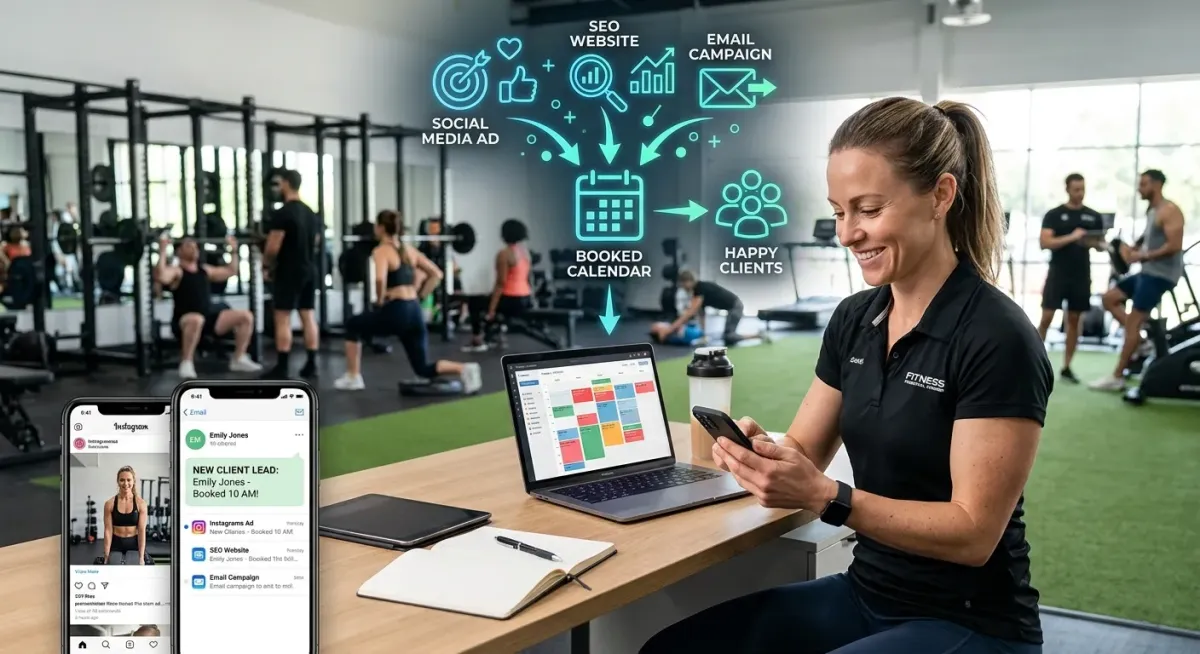
Digital Marketing for Personal Trainers to Get Personal Training Clients
The personal fitness trainer industry is booming, valued at $13.9 billion in 2025 and projected to hit $43.3 billion by 2036.
But so is the competition. There are now over 329,000 personal training businesses in the US, and no single company holds more than 5% market share.
Standing out is no longer about being the most qualified trainer in the room. It is about being the most visible one. This guide breaks down exactly how digital marketing for personal trainers works, from paid ads to SEO to email, so you can consistently fill your calendar with paying clients.
Why Most Personal Trainers Struggle to Get Consistent Clients
If you have been wondering how to get personal training clients beyond referrals and word-of-mouth, you are not alone, and you are asking exactly the right question.
Most personal trainers rely on referrals and word-of-mouth to grow. And while referrals are powerful, they are unpredictable. You cannot scale them, you cannot control when they come in, and when they slow down, so does your revenue.
Without a deliberate personal trainer marketing plan, even the most skilled trainers can struggle to gain visibility and attract clients. The trainers who build thriving, fully-booked businesses are the ones who invest in marketing systems that work regardless of referrals, systems that bring in leads consistently, nurture them over time, and convert them into paying clients.
Digital marketing for fitness coaches, and more specifically, a structured fitness client acquisition system, solves three core problems:
Visibility. Potential clients cannot hire you if they cannot find you. Your target audience spends time online researching fitness solutions, comparing trainers, reading reviews, and watching workout previews before ever making contact.
Trust. A strong digital presence increases visibility and helps build trust with potential clients. Higher engagement on social platforms leads to more inquiries and bookings, and an active profile with regular content updates builds a solid online reputation.
Predictability. A well-run paid ads system brings in leads consistently, not just when someone happens to mention you to a friend.
Step 1: Define Your Niche Before You Market Anything
The single biggest mistake personal trainers make with personal training niche marketing is trying to speak to everyone. Broad messaging dilutes your impact. Personalization and niche specialization stand as major industry drivers for 2025. Specializing in a specific client type makes your marketing significantly more effective, as you create targeted messages that speak directly to those people's needs.
Nail down your personal training niche and tailor all of your marketing content to that target audience. Think about who your happiest clients are, the people who understand the value of your service, have worked with you the longest, and are eager to refer others.
Strong niche examples include:
Busy professionals who want to lose weight without spending hours in the gym
Postpartum women returning to fitness after pregnancy
Senior fitness and mobility training
Athletes focused on strength and conditioning
Online coaching for people who travel frequently
Niche specialization is a critical differentiator in a crowded market. Focusing on specific demographics allows for premium pricing and fosters stronger client loyalty. Once you know who you serve, every piece of marketing, your website copy, your social posts, your ads, becomes sharper and more effective.
Step 2: Build a Website That Works as Your #1 Sales Tool
Your personal trainer website is the hub of all your online personal trainer marketing. It is where paid ads, social media, and organic search all point. A professional website does more than look good, it answers your ideal client's questions, builds trust, and makes it easy to take the next step.
An attractive and well-structured website will set you up for long-term success. Blogging is an underrated method for attracting clients. By demonstrating knowledge of specific subjects within personal training, you build authority and credibility in the field, which is also the foundation of strong personal trainer SEO.
Your personal trainer website needs:
A clear headline that states who you help and what outcome they can expect
A compelling offer, free consultation, downloadable workout plan, or a trial session
Client testimonials and transformation stories
A simple booking or contact form that is easy to find
Blog content that demonstrates expertise and improves SEO rankings
Publishing consistent, keyword-focused content around topics your clients are searching for builds search engine visibility over time and positions you as an authority before someone ever contacts you.
Step 3: Run Paid Ads to Fill Your Calendar Faster
Organic marketing builds long-term trust. Paid advertising builds immediate momentum. For personal trainers who want to accelerate personal training lead generation and fill their calendar quickly, paid ads are one of the most powerful tools available.
Meta Ads
Meta ads for personal trainers have become an essential tool for those looking to scale their business. With over 2.9 billion active users and sophisticated targeting options, the platform offers an opportunity to reach potential clients who are actively searching for fitness guidance. Unlike organic social media reach, which often only hits around 10% of your followers, paid advertising puts your services in front of the exact people who need them.
The primary advantage of Meta ads for fitness professionals is granular targeting. Trainers can reach ideal clients based on demographics, specific fitness interests, and behavior, whether you specialize in strength training, weight loss, or sports-specific conditioning.
Practical starting points for your fitness marketing strategy on Meta:
Start with a daily budget of $10 to $20 for a 7 to 14-day test phase
For local in-person training: target your city plus a 10 to 15-mile radius, ages 25 to 55
Use Lead Generation campaigns so prospects can submit their info without leaving the app
Build Custom Audiences from your email list, then create Lookalike Audiences to scale reach
Retarget website visitors who did not book, these are warm leads who already know you
Google Ads
Google ads for personal trainers capture people actively searching for help, these are warm leads already interested in hiring someone. Key benchmarks to know:
Average cost-per-click runs $1.50 to $5 for general keywords
Specialty keywords like "postnatal trainer" or "powerlifting coach" are cheaper at $1 to $3 and attract highly targeted audiences
Cost per new client inquiry typically ranges from $15 to $60, and given monthly training packages worth $300 to $1,000 or more, even a $60 cost per lead delivers strong long-term returns
People who click through a Google ad convert at a rate of around 4.2%, compared to just 0.55% for standard organic search results.
January is the single most important month for personal trainer advertising. Start campaigns in late December and maximize budget from January 1 through 31, this is when motivated people are searching with the most intent.
Step 4: Build Your Personal Brand on Social Media
Social media for personal trainers, including Instagram, Facebook, and TikTok, offers dynamic ways to connect with potential clients. By regularly posting workout videos, client testimonials, and fitness tips, trainers can build credibility and increase visibility.
The most effective social content for personal trainers:
Client success stories and transformation results (with permission)
Educational content, tips on nutrition, workout technique, or recovery
Behind-the-scenes of your training sessions
Your personal fitness journey and authentic experiences as a coach
Responses to common questions or objections from potential clients
Creating video content like tutorials and demonstration videos offers an interactive way for followers to learn. Producing a podcast discussing fitness trends or interviewing other fitness professionals provides another platform to reach an audience.
A critical principle for health coach advertising: keep promotional posts to a minimum and broadcast them with purpose. It is important to do this strategically so your audience sees you as a fitness professional, not a salesperson.
Step 5: Use Email Marketing to Nurture Leads and Retain Clients
Email marketing for fitness coaches is one of the most effective digital marketing strategies available, even more effective than social media for converting leads into paying clients. Every email address you collect is a direct line to a potential client that does not depend on any algorithm.
Email is still one of the highest-ROI channels for trainers. Every email address you collect is an opportunity to send value, check in, and stay top-of-mind without fighting the algorithm.
How to structure your email marketing as part of your broader fitness business marketing system:
Lead magnet: Offer a free 5-day workout plan, a nutrition guide, or a free consultation in exchange for an email address
Welcome sequence: Introduce who you are, what you offer, and what the subscriber can expect
Newsletter: Send weekly or bi-weekly with client wins, practical tips, and behind-the-scenes content
Campaigns: Time-based promotions around New Year, spring, and back-to-school seasons
Retargeting sequences: Follow up with leads who expressed interest but did not convert
Tools like ConvertKit and MailerLite are free to start and require no technical background. The goal is simple: stay top-of-mind so that when a subscriber is ready to invest in training, you are the first person they think of.
Step 6: Use AI Tools to Work Smarter, Not Harder
The fitness industry is rapidly embracing AI, and for trainers focused on personal training business growth, these tools represent a genuine competitive edge. In January 2025, Virtuagym launched an AI-powered fitness coach serving 20 million consumers and expanding to 9,000 fitness businesses and 45,000 trainers globally. Mindbody also launched new AI-powered features to improve member retention and enhance business efficiency for wellness and fitness businesses.
For individual personal trainers, AI tools can dramatically reduce the time spent on marketing tasks. AI can help you draft client emails, write social media captions, create workout content, analyze ad performance, and build automated follow-up sequences, freeing up more time for what you actually do best: train clients.
2026 is shaping up to be the year of AI-driven discovery. People are increasingly asking AI assistants to recommend service providers, and paid ads and AI-based recommendations are beginning to merge. The trainers who build a strong digital presence now will win visibility before competitors even know the game has changed.
Putting It All Together: A Full-Funnel Marketing System
The most successful fitness coaches do not rely on any single channel. They build a personal trainer marketing plan where each piece of marketing supports the others.
Here is what a full-funnel strategy looks like:
Awareness: Facebook ads for personal trainers, Google search ads, local personal trainer marketing through SEO-optimized blog posts, and social media content drive potential clients to discover you.
Consideration: Your personal trainer website, client testimonials, and email sequences build trust and answer their key questions.
Conversion: A clear offer, free consultation, trial session, or a limited-time promotion — converts interested leads into paying clients.
Retention: Email newsletters, client check-ins, loyalty offers, and community building keep existing clients engaged and referring others.
This kind of system does not happen overnight. But once it is in place, it generates leads consistently, regardless of referrals, seasons, or word-of-mouth fluctuations.
The trainers who win in a saturated market are not the ones with the most credentials, they are the ones who show up consistently online, speak directly to their ideal client's pain points, and back that up with a system that converts attention into appointments.
Waqar Ahmed, Founder, Tectanic
FAQs
Ready to Fill Your Calendar With Qualified Clients?
Building a predictable client pipeline takes the right strategy — and the right team behind you.
Tectanic is one of the leading advertising agencies in Delaware, specializing in performance marketing and AI automation for fitness professionals and coaches. If you are ready to invest in digital marketing for personal trainers that actually convert, or need a complete personal trainer marketing plan built from the ground up, we help personal trainers build paid ad systems, automated funnels, and AI-powered client acquisition pipelines that generate consistent leads month after month.
Whether you are just starting out or ready to scale past your current capacity, we can build the marketing infrastructure to get there. Reach out to the Tectanic team today to learn how we can build a client acquisition system tailored to your training business.